On this page
Key points
- Social Security’s 2027 cost-of-living adjustment (COLA) is 3.6%. The average retired worker’s benefit goes from about $2,095 to $2,170 a month, roughly $75 more before Medicare.[1][2]
- On a $2,000 benefit, the raise is $72. After the projected 2027 Part B premium of $209.50, you’d keep about $65.40 more a month. That premium is a projection. Medicare hasn’t announced the official amount.[3][4]
- The hold harmless rule protects most people’s payment from going down because of a Part B increase. It doesn’t cover people new to Part B in 2027, people who pay IRMAA, or people whose state Medicaid agency pays their premium.[5]
- VA is required by law to match the Social Security COLA percentage, but the 2027 VA disability compensation increase still needs Congress to pass this year’s bill. As of October 15, 2026, it hadn’t.[6][7][8]
- Look for your COLA notice in your my Social Security Message Center starting in late November. To see it online, sign up for paperless notices by November 18.[1]
Watch: Social Security for Veterans: Your 2027 Raise After Part B
Social Security’s 2027 raise is official: 3.6%.[2] For the average retired worker, that’s about $75 a month. But that’s before Medicare takes Part B out. What veterans really want to know is what reaches the bank.
Here’s the short answer for a $2,000 benefit. The raise is $72. Subtract the projected 2027 Part B premium and you keep about $65.40 more each month. The rest of this page shows you how to run your own number, what can make yours different, and what changes for VA pay.
The official 2027 Social Security numbers
Social Security announced the 2027 COLA on October 14, 2026.[1] By law, the increase follows the Consumer Price Index for Urban Wage Earners and Clerical Workers (CPI-W), measured from the third quarter of 2025 through the third quarter of 2026.[1][2] You don’t apply for it. It’s automatic.
| Type of beneficiary | Before 3.6% COLA | After 3.6% COLA | Increase |
|---|---|---|---|
| All retired workers | $2,095 | $2,170 | +$75 |
| Aged couple, both receiving benefits | $3,238 | $3,355 | +$117 |
| Aged widow(er) alone | $1,936 | $2,005 | +$69 |
| All disabled workers | $1,642 | $1,701 | +$59 |
Averages published by Social Security, before Medicare premiums or any other deductions. Your increase depends on your own benefit.
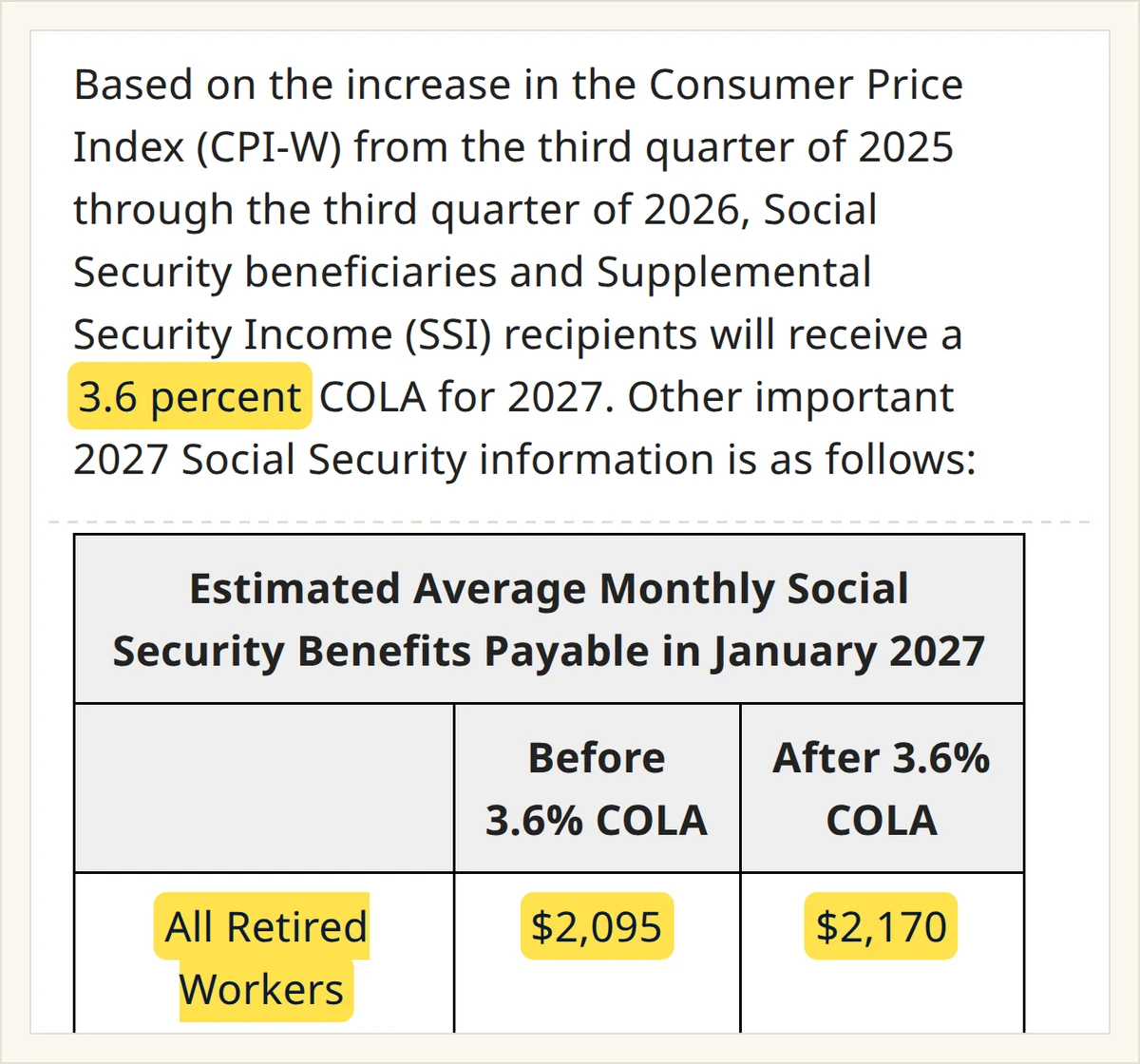
The raise starts with the Social Security payment you get in January 2027. If you get Supplemental Security Income (SSI), your first increased payment arrives December 31, 2026.[1] The SSI federal payment standard rises to $1,029 a month for an individual and $1,544 for a couple.[2]
How to work out your 2027 deposit after Part B
You need 3 numbers: your benefit before deductions, the 3.6% increase, and your Medicare premium. Here’s the order that gets it right.
- Start with your benefit before Medicare. Use your benefit notice or your benefit verification letter, which you can get in your my Social Security account. Don’t use your bank deposit. Your deposit is what’s left after Part B and any tax withholding come out.
- Multiply by 1.036. That’s your estimated 2027 benefit before deductions. On $2,000, that’s $2,072, a raise of $72.
- Subtract your Part B premium. The standard premium is $202.90 a month in 2026.[4] For 2027, the Medicare Trustees estimate $209.50.[3] That’s a projection. The official 2027 premium hadn’t been announced as of October 15, 2026.
- Subtract your other deductions. If a Medicare Advantage (Part C) or Part D premium comes out of your Social Security, include it. Same with federal income tax withholding. Use your own amounts, not someone else’s.
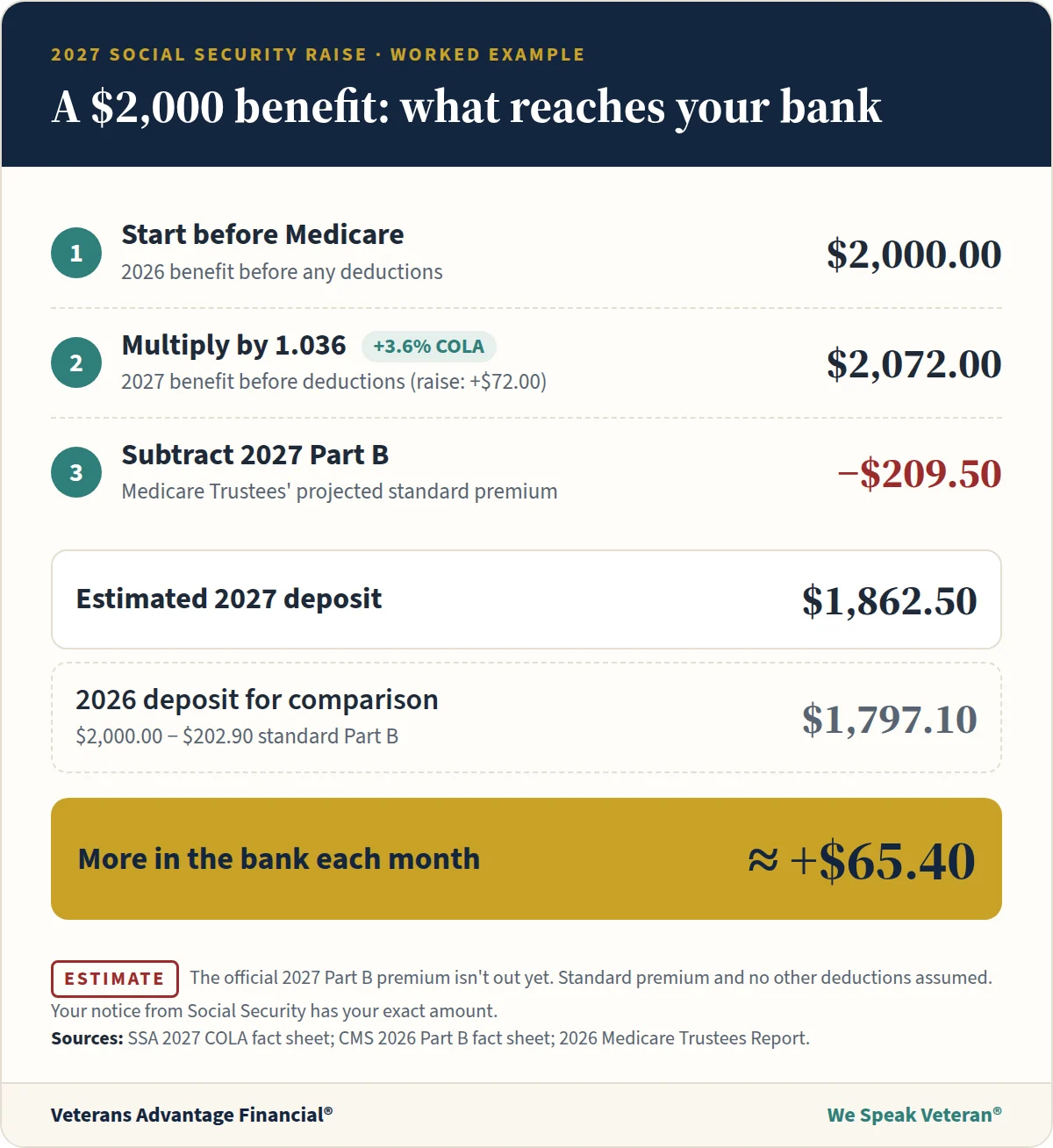
So in this example, the $72 raise becomes about $65.40 more in the bank. The difference is the projected $6.60 increase in the standard Part B premium.
This is a planning estimate. Social Security’s own calculation and rounding can differ. Your official COLA notice and your actual deductions settle the final amount.
Calculator: your 2027 raise after Part B
Enter your 2026 benefit before deductions. The calculator applies the 3.6% COLA and the Trustees’ projected 2027 standard Part B premium. If you don’t pay the standard premium, enter what you actually pay.
- 2027 benefit before deductions
- $2,072.00
- Gross raise (3.6%)
- +$72.00
- Estimated 2027 deposit
- $1,862.50
- 2026 deposit
- $1,797.10
- Estimated change in your monthly deposit
- +$65.40
Estimate only. Uses the official 3.6% COLA and, by default, the Trustees’ projected 2027 standard Part B premium. Does not calculate IRMAA or the hold harmless rule. Social Security’s own calculation and rounding can differ. Your COLA notice has your exact amount.
This is an unadjusted planning estimate, not a prediction of your official payment. If the result shows a decrease, hold harmless may prevent that decrease if you qualify. Other deductions are assumed to stay the same in both years.
The 2027 raise after Part B at 5 benefit amounts
| 2026 benefit before deductions | 2027 benefit (× 1.036) | Gross raise | Estimated change in deposit after Part B |
|---|---|---|---|
| $1,500 | $1,554.00 | +$54.00 | +$47.40 |
| $2,000 | $2,072.00 | +$72.00 | +$65.40 |
| $2,095 (2026 average retired worker) | $2,170.42 | +$75.42 | +$68.82 |
| $2,500 | $2,590.00 | +$90.00 | +$83.40 |
| $3,000 | $3,108.00 | +$108.00 | +$101.40 |
Change in deposit = (2027 benefit − $209.50) − (2026 benefit − $202.90). The $209.50 is a projection, not the official premium. People who pay IRMAA, get help with Part B or have other deductions will see different numbers. Social Security rounds its published 2027 average to $2,170.
Notice the pattern. In every row, the projected Part B increase takes the same $6.60. The bigger your benefit, the bigger your raise, so the smaller that $6.60 bite looks. If your benefit is under $2,000, I explain how the Part B deduction works in How the 2026 Medicare Part B Premium May Be Deducted.
The hold harmless rule: who it protects and who it doesn’t
What if someone’s raise is too small to cover a Part B increase? That’s what this rule is for.
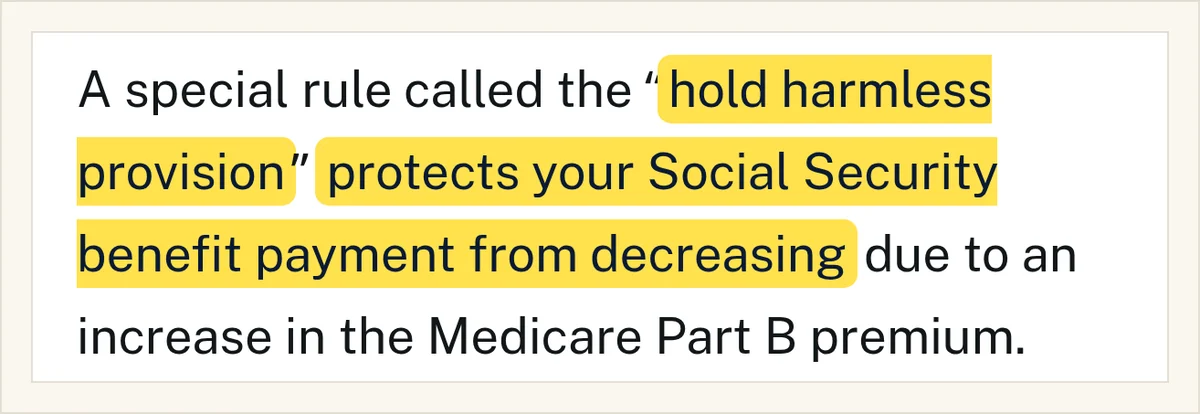
“A special rule called the ‘hold harmless provision’ protects your Social Security benefit payment from decreasing due to an increase in the Medicare Part B premium.”
For the change into 2027, you generally qualify if both of these are true:[5]
- You receive, or are entitled to, Social Security benefits for November and December 2026.
- Your Part B premiums for December and January are deducted from your benefits.
The rule doesn’t cover everyone. It doesn’t protect:[5]
- People enrolling in Part B for the first time in 2027.
- People who pay the higher-income Medicare charge called IRMAA. That stands for income-related monthly adjustment amount.
- People whose Part B premium is paid by their state Medicaid agency.
Two more things to know. The rule only covers the Part B increase. It doesn’t stop your deposit from changing for other reasons, like a new Part D premium or a change in tax withholding. And for people who are protected, Part B can still use up some or all of their raise. The rule keeps the payment from going down. It doesn’t promise a raise.
How small would a benefit have to be for the raise to fall short? With the projected $6.60 Part B increase, a 3.6% raise covers it on any benefit above about $183.33 a month ($6.60 ÷ 0.036). That lines up with what Social Security says: most people pay the new premium because their benefit increase covers it.[5]
Why my dad’s Part B deduction is $17.90, not $202.90

Don’t assume another veteran has the same deduction you do. My dad is a good example.
My dad, Wallace, is 82 and a Vietnam-era veteran. His 2026 Medicare Advantage (Part C) plan has a $0 monthly plan premium and helps pay $185 of his $202.90 Part B premium. That leaves him paying $17.90 a month toward Part B. He isn’t getting any low-income help.
That isn’t a special COLA for Dad. Social Security gives him the same 3.6% as everyone else. His Medicare plan changes what he pays toward Part B, so less comes out of his check.
Medicare’s own handbook explains how this works. On page 11, it says:
“Some plans may have a $0 premium and may help pay all or part of your Part B premium.”

Dad still uses VA care. VA says having other health coverage doesn’t affect the VA health care benefits you can get.[10] But where you get care, and which coverage you use, still matters.
If you’re reviewing coverage for 2027, Medicare’s Open Enrollment runs October 15 through December 7.[9] Compare the full coverage, not just what shows up in your deposit. You can compare plans at Medicare.gov/plan-compare or with a licensed agent.
VA disability compensation: the same 3.6%, but it still needs a vote
VA disability compensation gets a cost-of-living adjustment too. VA’s rates page says:
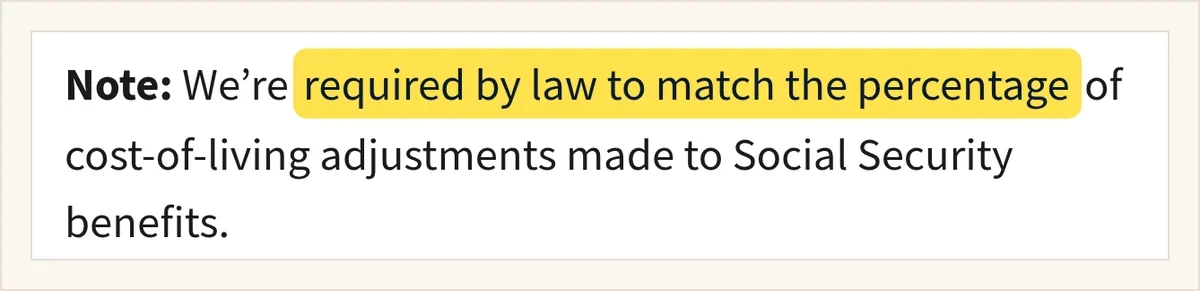
“We’re required by law to match the percentage of cost-of-living adjustments made to Social Security benefits.”
Here’s the part most people miss. For VA disability compensation, Congress passes a new law every year that turns the increase on. For 2027, that’s the Veterans’ Compensation Cost-of-Living Adjustment Act of 2026. As of October 15, 2026, it hadn’t passed.
| Bill | Latest action |
|---|---|
| H.R. 8552 (House) | Forwarded by subcommittee to the full House Committee on Veterans’ Affairs, June 30, 2026[7] |
| S. 4487 (Senate) | Referred to the Senate Committee on Veterans’ Affairs, May 11, 2026[8] |
The bill would raise disability compensation, the extra amounts for dependents, the clothing allowance and Dependency and Indemnity Compensation (DIC) by the same percentage as Social Security, effective December 1, 2026.[7]
Should you worry? The record says this bill usually becomes law before its December 1 effective date. Here’s when it became law in each of the last 4 years:[11]
| COLA year | Became law | Before December 1? |
|---|---|---|
| 2022 | October 10, 2022 | Yes |
| 2023 | June 14, 2023 | Yes |
| 2024 | November 25, 2024 | Yes |
| 2025 | November 25, 2025 | Yes |
Last year’s bill passed the Senate by unanimous consent and the House by voice vote.[11] That’s a pattern, not a guarantee. And there’s nothing for you to file, apply for or call about.
| Disability rating | 2026 monthly rate | 2027 estimate at 3.6% | Estimated increase |
|---|---|---|---|
| 10% | $180.42 | $186.92 | +$6.50 |
| 30% | $552.47 | $572.36 | +$19.89 |
| 50% | $1,132.90 | $1,173.68 | +$40.78 |
| 70% | $1,808.45 | $1,873.55 | +$65.10 |
| 100% | $3,938.58 | $4,080.37 | +$141.79 |
2026 rates from VA, effective December 1, 2025. The 2027 figures are my estimate (2026 rate × 1.036, rounded to the cent). They are not official. VA publishes 2027 rates after the law passes, and its rounding may differ. Rates with dependents are higher.
Other veteran payments work differently:
- VA pension, including Aid and Attendance rates, increases automatically with the Social Security COLA under federal law. It doesn’t wait for the annual bill.[12]
- Military retired pay also adjusts automatically on December 1 under federal law, and Military Times reports a 3.6% increase for 2027.[13][14] Retirees under the REDUX plan generally get 1 percentage point less.[13]
December 1 is an effective date, not a payment date. Check the payment date for your own benefit.
If you get both Social Security and VA disability compensation, figure each increase separately. Don’t subtract Medicare from your VA payment when you’re working out the Social Security example. Social Security says SSDI and VA disability compensation “are not affected by each other.”[15] SSI is different, because it depends on your income and resources.[15] For more on collecting more than one benefit, see Can I Collect Military Retirement, VA Disability, and Social Security?
Key dates for your 2027 raise
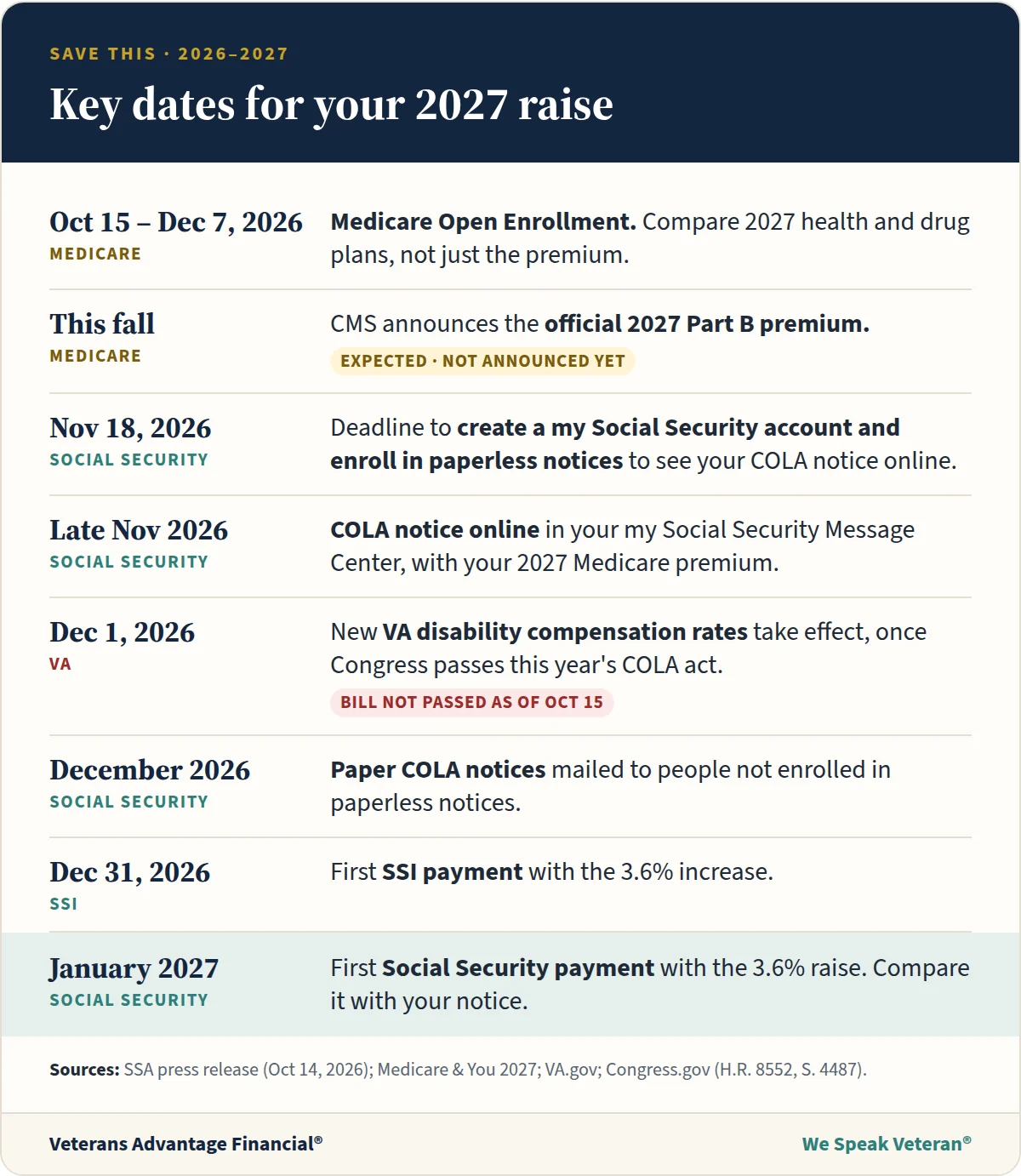
| Date | What happens |
|---|---|
| October 15 – December 7, 2026 | Medicare Open Enrollment for 2027 coverage[9] |
| Not announced yet | Medicare announces the official 2027 Part B premium |
| November 18, 2026 | Deadline to create a my Social Security account and sign up for paperless notices if you want to see your COLA notice online[1] |
| Late November 2026 | COLA notice and your 2027 Medicare premium amount appear in your my Social Security Message Center[1] |
| December 1, 2026 | New VA disability compensation rates take effect, if this year’s bill becomes law.[7] Military retired pay adjusts.[13] |
| December 2026 | Paper COLA notices mailed[1] |
| December 31, 2026 | First SSI payment with the 3.6% increase[1] |
| January 2027 | First Social Security payment with the 3.6% raise[1] |
How to check your COLA notice against your estimate
Social Security’s 2027 COLA notice is 1 page. It shows your new benefit amount and your deductions.[1] When it arrives, check it in this order:
- Your benefit before deductions. Compare it with your 1.036 estimate.
- Your Part B amount. Is it the standard premium, a reduced amount, or a higher IRMAA amount?
- Your other deductions. Look for Part C or Part D premiums and tax withholding.
If your number is different from your estimate, those are the first places to look.
If you pay IRMAA
Use your actual premium, not the standard example. Social Security sets IRMAA from the most recent federal tax return the IRS gives it. For 2026 premiums, that’s generally the return filed in 2025 for tax year 2024.[17] So your income one year can affect your Medicare premium 2 years later.
If a life-changing event lowered your income, Social Security may make a new decision. The listed events include marriage, divorce or the death of a spouse, and you or your spouse stopping work or cutting back hours.[17] You report it on Form SSA-44, and you’ll need documents that show the event and the drop in income.[17] I explain the brackets in IRMAA 2026: What Higher Income Does to Your Medicare Premium.
What’s still coming, and when I’ll update this page
- When Medicare announces the official 2027 Part B premium, I’ll update the example, the table and the calculator.
- When this year’s VA compensation bill becomes law and VA posts its 2027 rates, I’ll update the VA section.
The 3.6% is official. Your personal deposit depends on your benefit and your deductions. Your raise also starts with the benefit Social Security has on record for you. If you had active-duty service from 1957 through 2001, Social Security may have added extra earnings credits to your record.[18] I show you how to check in How Military Service Can Add Earnings to Your Social Security Record.
Common questions
How much is the Social Security raise for 2027?
The 2027 cost-of-living adjustment is 3.6%. Social Security estimates the average retired worker’s benefit goes from $2,095 to $2,170 a month, about $75 more, before Medicare premiums and other deductions. It starts with the January 2027 payment. SSI increases start December 31, 2026.[2][1]
How much of my 2027 raise will I keep after Medicare Part B?
Multiply your 2026 benefit before deductions by 1.036, then subtract your 2027 Part B premium and any other deductions. On a $2,000 benefit with the standard premium, the raise is $72, and you’d keep about $65.40 more a month using the Trustees’ projected $209.50 premium.[3] Your official COLA notice has your exact amount.
What is the 2027 Medicare Part B premium?
Medicare hadn’t announced it as of October 15, 2026. The 2026 Medicare Trustees Report estimates $209.50 a month, up from $202.90 in 2026.[3][4] Social Security says your 2027 premium amount will be in your my Social Security Message Center starting in late November.[1]
Can a Part B increase take my whole Social Security raise?
Yes. A Part B premium increase can use up some or all of your Social Security raise. If you qualify for hold harmless, that increase alone cannot reduce your Social Security payment. The protection does not apply to everyone, including people new to Part B, people who pay IRMAA, and people whose state Medicaid agency pays their premium. [5]
Do veterans get the 3.6% COLA on VA disability compensation?
VA says it’s required by law to match the Social Security COLA percentage, so 3.6% is expected. But the increase needs this year’s Veterans’ Compensation Cost-of-Living Adjustment Act to become law. As of October 15, 2026, H.R. 8552 and S. 4487 were still in committee.[6][7][8] In each of the last 4 years, the act became law before its December 1 effective date.[11]
Does VA disability compensation reduce my Social Security?
Social Security says SSDI and VA disability compensation are not affected by each other, so you may be able to get both. You apply for each separately. SSI is different because it depends on your income and resources.[15]
Do I need to apply for the 2027 COLA?
No. The Social Security COLA is automatic, and so is the VA increase once the law passes. Be careful with posts that ask for your direct-deposit information. VA warned on October 14, 2026 that a fake grant post fooled some veterans into giving up that information.[16]
When will I get my 2027 COLA notice?
Social Security posts it in your my Social Security Message Center starting in late November. To see it online, create an account and sign up for paperless notices by November 18. Paper notices are mailed in December.[1]
Keep learning
I wrote Medicare for Veterans: The Complete Field Guide for veterans and their families. You can read it free online.
Sources
- Social Security Administration. “Social Security Announces 3.6 Percent Benefit Increase for 2027.” Press release, October 14, 2026. ssa.gov/news/en/press/releases/2026-10-14.html
- Social Security Administration. “2027 Cost-of-Living Adjustment (COLA) Fact Sheet.” ssa.gov/news/en/cola/factsheets/2027.html
- Centers for Medicare & Medicaid Services. 2026 Annual Report of the Boards of Trustees of the Federal Hospital Insurance and Federal Supplementary Medical Insurance Trust Funds, transmitted June 9, 2026. Quote: “The estimated monthly premium for 2027 is $209.50.” cms.gov/oact/tr/2026
- Centers for Medicare & Medicaid Services. “2026 Medicare Parts A & B Premiums and Deductibles” (fact sheet), November 14, 2025. cms.gov/newsroom/fact-sheets/2026-medicare-parts-b-premiums-deductibles
- Social Security Administration. Darlynda Bogle, “How the Hold Harmless Provision Protects Your Benefits.” Social Security blog, November 30, 2020. ssa.gov/blog/en/posts/2020-11-30.html
- U.S. Department of Veterans Affairs. “Current Veterans disability compensation rates.” VA.gov, last updated December 2, 2025 (rates effective December 1, 2025). va.gov/disability/compensation-rates/veteran-rates
- Congress.gov (Library of Congress). “H.R. 8552 — Veterans’ Compensation Cost-of-Living Adjustment Act of 2026,” 119th Congress. Text and all actions, checked October 15, 2026. congress.gov/bill/119th-congress/house-bill/8552
- Congress.gov (Library of Congress). “S. 4487,” 119th Congress, Senate companion to H.R. 8552. All actions, checked October 15, 2026. congress.gov/bill/119th-congress/senate-bill/4487
- Centers for Medicare & Medicaid Services. Medicare & You 2027 (official Medicare handbook), page 11 and Open Enrollment dates. medicare.gov/publications/10050-medicare-and-you.pdf
- U.S. Department of Veterans Affairs. “VA health care and other insurance.” VA.gov, last updated July 14, 2025. va.gov/resources/va-health-care-and-other-insurance
- Congress.gov (Library of Congress). Annual Veterans’ Compensation Cost-of-Living Adjustment Acts and dates they became law: H.R. 7846 (October 10, 2022); S. 777 (June 14, 2023); H.R. 7777 (November 25, 2024); S. 2392 (November 25, 2025; all actions). congress.gov/bill/117th-congress/house-bill/7846 · congress.gov/bill/118th-congress/senate-bill/777 · congress.gov/bill/118th-congress/house-bill/7777 · congress.gov/bill/119th-congress/senate-bill/2392/all-actions
- Legal Information Institute, Cornell Law School. 38 U.S. Code § 5312, “Annual adjustment of certain benefit rates.” law.cornell.edu/uscode/text/38/5312
- Legal Information Institute, Cornell Law School. 10 U.S. Code § 1401a, “Adjustment of retired pay and retainer pay to reflect changes in Consumer Price Index.” law.cornell.edu/uscode/text/10/1401a
- Military Times. “Here’s the 2027 cost-of-living increase for retirees, veterans,” October 14, 2026. militarytimes.com/pay-benefits/mil-money/2026/10/14/heres-the-2027-cost-of-living-increase-for-retirees-veterans
- Social Security Administration. “Information for Military & Veterans.” ssa.gov/people/veterans
- VA News. “Deepfake phishing: Don’t be fooled.” VA Office of Information and Technology, October 14, 2026. news.va.gov/149747/deepfake-phishing-dont-be-fooled
- Social Security Administration. “Premiums: Rules for Higher-Income Beneficiaries.” Includes Form SSA-44 and life-changing events. ssa.gov/benefits/medicare/medicare-premiums.html
- Social Security Administration. “Special Extra Earnings for Military Service.” ssa.gov/benefits/retirement/planner/military.html
Sources checked October 15, 2026. Dollar amounts are 2026 unless noted. The 2027 Part B premium and 2027 VA rates on this page are estimates.
I am not affiliated with or endorsed by Social Security, Medicare, VA, TRICARE or any government agency. Nor would I want to be. This is general education, not personal advice. I am not recommending any specific plan or telling you what to enroll in. The 2027 Part B and VA amounts on this page are estimates for planning. Always review your own situation with Social Security, VA, Medicare or a professional you trust before making changes.

Christopher Duncan
Christopher founded Veterans Advantage Financial® and has helped people with Medicare since 2006. He is a licensed insurance agent in all 50 states and DC (NPN 8613503). His dad, Wallace, is a Vietnam-era veteran.